
Have you ever wondered how a Self-Driving Car traveling on the road actually understands its surroundings? How does it know that the object in front of it is a human, another car, or just a traffic light?
We are all familiar with generative AI tools like ChatGPT and Gemini that create text and images. However, behind the scenes, there are specialized tools that teach AI how to “see.” One of the biggest names in this field is Deepen AI.
In this article, we will explain in simple terms what Deepen AI is, how it works, and why it is absolutely essential for the future of Autonomous Vehicles (self-driving cars).
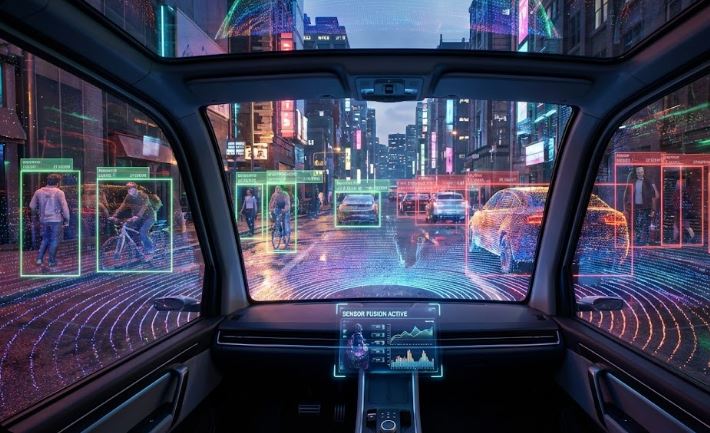
What is Deepen AI
Simply put: Deepen is like a “teacher” who teaches other AI models to “see” and “understand”.
When we use ChatGPT or Midjourney, they are “Generative AI” (they create new things). But Deepen AI’s job is “Data Annotation” (labeling data).
Technically speaking, Deepen AI is a technology company that builds tools for Data Annotation and Sensor Calibration. Their primary focus is on helping Autonomous Vehicles, Robotics, and Computer Vision systems function correctly.
When an AI system is first built, it is like a “blank slate.” It doesn’t know what a car or a tree looks like. By using Deepen AI’s tools, engineers show the AI millions of images and videos, labeling them clearly—”This is a car,” “This is a tree,” or “This is the road.”
How Does Deepen AI Work? (Core Features)
Deepen AI solves two major problems in the world of Artificial Intelligence:
A. Data Annotation (Labeling the Data) Imagine a self-driving car’s camera takes a photo of the street. To the car’s computer, that photo is just a collection of pixels (dots). Deepen AI provides tools (like Deepen Annotate) that allow humans to draw precise boxes on objects in that photo.
- 2D Bounding Boxes: Drawing a box around cars and pedestrians so the AI recognizes them. This is the simplest form. Annotators draw a rectangular box around objects like cars, pedestrians, and cyclists. It tells the AI, “This object exists here.”
- Semantic Segmentation: Coloring every single pixel of the road to define exactly where the car can drive. This is pixel-perfect precision. Every single pixel in the image is colored according to its category. For example, all “road” pixels are gray, and all “sky” pixels are blue. This helps the car understand exactly where the drivable road ends and the sidewalk begins.
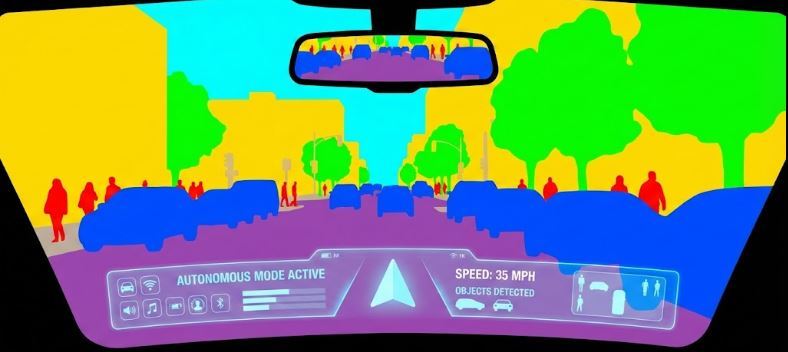
Image: An example of Semantic Segmentation, where the AI sees the world in color-coded categories (e.g., Road=Purple, Cars=Blue, Pedestrians=Red).
B. Sensor Fusion & Calibration (The Most Important Part) : A smart car doesn’t just rely on a camera; it also uses LiDAR (laser sensors and Radar). Since the real world is 3D, 2D boxes aren’t enough. Deepen AI places 3D boxes around objects in the point-cloud data. This tells the car not just what the object is, but also its volume, size, and rotation.
- The Camera sees “Color” and visual details.
- The LiDAR sees “Distance” and “Depth” (how far away an object is).
Deepen AI’s tool (Deepen Calibrate) mixes (fuses) the data from these different sensors into one clear picture. If this calibration is slightly off, the car might think an object is far away when it is actually close, which could lead to an accident.
Why is Deepen AI Important?
In today’s world, AI safety is the top priority. Deepen AI is crucial for the following reasons:
Safety First: If there is even a 1% error in data labeling, it could cause an accident on the road. Deepen AI tools ensure the training data is accurate and high-quality.
Handles Complex Scenarios: This system can accurately process data even in difficult conditions like heavy fog, rain, or pitch-dark nights, ensuring cars can drive safely in any weather.
Saves Time: Previously, labeling data took months of manual effort. With Deepen AI’s “AI-assisted tools,” this process is now 10x faster.
The “Human-in-the-Loop” Concept
Many people think AI does everything on its own. However, Deepen AI operates on a principle called “Human-in-the-Loop” (HITL).
AI models are fast, but they can make mistakes—especially in confusing situations like a snowman on the side of the road or a person wearing a costume. In these “Edge Cases,” Deepen AI’s software flags the confusing image and sends it to a human expert. The human corrects the label, and the AI learns from this correction. This combination of AI Speed + Human Accuracy is what makes the technology safe.
Humans should have an active role in the AI decision-making process.
Understand the process in 4 simple steps:
- AI generates the output.
- A human reviews the output.
- The human provides corrections/feedback.
- The AI performs even better in the future.
Where is it Used? (Real-World Use Cases)
This technology isn’t just limited to cars; it is used in various industries:
Autonomous Vehicles: Providing training data for major companies like Tesla or Waymo.
Agriculture: Powering smart tractors that can identify and remove “weeds” while leaving the crops unharmed.
Robotics: Helping warehouse robots pick up packages without colliding with shelves or people.
Career Opportunity: Can You Work in This Field?
As the AI industry grows, the demand for “Data Annotators” is skyrocketing. You don’t always need a coding degree to enter this field.
- Quality Assurance (QA) Specialist: Senior roles involve checking the work of annotators to ensure 99.9% accuracy.
- Data Annotator: If you have a keen eye for detail, many companies hire freelancers to label images using tools similar to what Deepen AI provides.
AI adoption is booming across industries, meaning companies need smarter, deeper AI systems
By understanding how tools like Deepen AI work, you position yourself for a future-proof career in the backend of the Artificial Intelligence industry.
Also Read:
Free AI tools Without Watermark
Best AI Image Generator for Social Media
FAQs:
Q1: How is Deepen AI different from ChatGPT or Midjourney?
Ans: While ChatGPT and Midjourney are Generative AI tools (creating text or images), Deepen AI is a Computer Vision tool. It does not create new content; instead, it helps machines understand and label existing real-world data so they can navigate physical environments.
Q2: Is Deepen AI free to use?
Ans: No, Deepen AI is primarily an enterprise-grade (B2B) platform designed for large automotive companies, robotics firms, and tech developers. It is not a free consumer app like typical chatbots, as it requires high processing power for industrial tasks.
Q3: Why do self-driving cars need human annotators?
Ans: AI is smart but not perfect. In complex situations (like heavy rain or confusing road signs), AI might make mistakes. Human annotators use Deepen AI tools to manually correct these errors (“Human-in-the-Loop”), teaching the AI to handle difficult scenarios safely in the future.
Q4: What is “Sensor Fusion” in Deepen AI?
Ans: Sensor Fusion is the process of combining data from multiple sources—like Cameras (for color), LiDAR (for depth), and Radar (for speed)—into a single, accurate 3D view. Deepen AI’s calibration tools ensure these sensors work together perfectly to prevent blind spots.
Final Word
Deepen AI is the “silent hero” that people rarely talk about, but without it, the dream of fully self-driving cars cannot be realized. This company ensures that machines can understand the physical world just as well as we humans do.
If you are looking to build a career in the AI field, “Data Annotation” and “Computer Vision” are becoming massive markets, and Deepen AI is a leader in this space.